
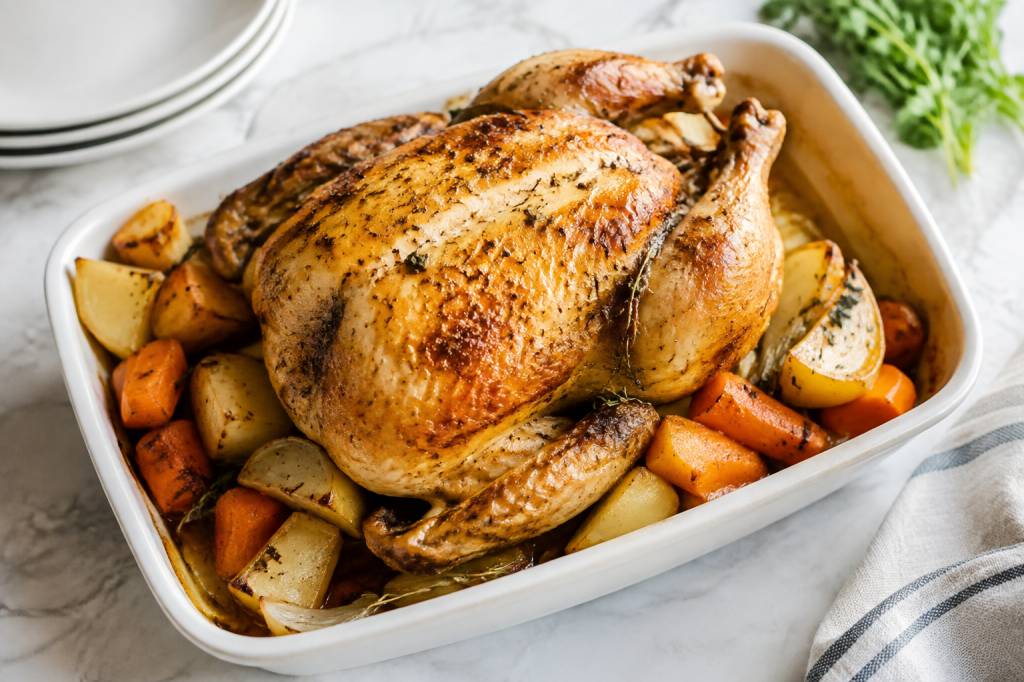
Roasting a 1.6 kg chicken is one of the simplest ways to put a proper meal on the table. It is also one of those jobs that can create unnecessary doubt. Is the cooking time really enough? Should the oven be hotter? Why is the breast dry while the legs are still catching up?
The good news is that a 1.6 kg chicken is a very manageable size. With the right oven temperature, a reliable cooking time and a few practical checks, you can serve chicken with crisp skin, tender meat and plenty of useful juices for gravy.
How long does a 1.6 kg chicken take to cook?
For a standard whole chicken weighing 1.6 kg, allow approximately 1 hour 40 minutes to 1 hour 45 minutes in a preheated oven.
A useful British roasting formula is:
- 20 minutes per kilogram
- Plus an additional 70 minutes
For a 1.6 kg chicken, that works out as:
- 1.6 kg × 20 minutes = 32 minutes
- 32 minutes + 70 minutes = 102 minutes
- Total cooking time: approximately 1 hour 42 minutes
This guideline is intended for an unstuffed chicken roasted at around 190°C conventional or 170°C fan. Oven temperatures vary, so treat the calculation as a dependable starting point rather than an unbreakable law of nature. Your oven, the shape of the bird and whether the chicken went into the oven straight from the fridge can all affect the result.
The best oven temperature for roasting chicken
For an even roast, preheat the oven to 190°C or 170°C fan. In Fahrenheit, this is approximately 375°F or 340°F fan.
This temperature is hot enough to brown the skin without burning it before the meat has cooked through. If you prefer very crisp skin, you can begin at 200°C conventional or 180°C fan for the first 15 minutes, then reduce the temperature to 190°C conventional or 170°C fan for the remainder of the cooking time.
A moderate oven is usually more forgiving than an extremely hot one. High heat can make the skin look finished while the thicker parts of the chicken are still undercooked. Nobody wants a roast that looks impressive from across the kitchen but needs another half hour when carved.
Preparing the chicken before it goes into the oven
Remove the chicken from its packaging and take out the giblets if they are inside the cavity. Pat the skin dry with kitchen paper. This small step matters because damp skin steams rather than roasts, making it harder to achieve that golden, lightly crisp finish.
Leave the chicken at room temperature for around 20 to 30 minutes before roasting if your kitchen is cool. Do not leave raw chicken sitting out for several hours. The aim is simply to remove some of the refrigerator chill, not to turn the kitchen counter into a warm-up station for bacteria.
Rub the skin with a little oil or softened butter, then season generously with salt and pepper. You can keep the flavour simple or add garlic, thyme, rosemary, lemon zest or smoked paprika. For a traditional roast, place a halved onion, a lemon wedge or a few herbs inside the cavity. These will add aroma, although they will not dramatically change the cooking time.
If you want the skin to brown evenly, tuck the wing tips underneath the bird. You can tie the legs together with kitchen string, but do not pull them tightly against the body. A little space helps hot air circulate and allows the legs to cook properly.
Should a 1.6 kg chicken be covered?
Usually, a chicken does not need to be covered while it cooks. Leaving it uncovered allows the skin to brown and crisp.
If the skin is becoming too dark before the chicken is fully cooked, loosely cover the breast area with foil. Do not wrap the whole chicken tightly, as this can trap steam and soften the skin. A loose foil shield protects the breast while the legs and thighs continue cooking.
You can also place the chicken on a bed of onions, carrots or celery. This keeps the underside slightly raised, adds flavour to the juices and gives you vegetables that can be used in gravy. A roasting rack is useful, but it is not essential.
How to know when the chicken is cooked
Cooking time is useful, but temperature is the most reliable way to check a whole chicken. Insert a meat thermometer into the thickest part of the thigh, avoiding the bone. The internal temperature should reach at least 75°C.
You can also check the thickest part of the breast. The juices should run clear, and the meat should no longer look pink or translucent. However, clear juices alone are not always a perfect test, particularly with modern poultry. A thermometer gives you a much better answer than staring at the bird and hoping for the best.
When checking the temperature, make sure the thermometer is not touching bone, as this can produce an inaccurate reading. Check more than one place if you are unsure, especially in the thigh and near the breast.
If the chicken has not reached a safe temperature after the suggested 1 hour 42 minutes, return it to the oven and check again every 10 minutes. Smaller variations are normal. A compact, plump chicken may take slightly longer than a flatter bird of the same weight.
Why the chicken may need more or less time
The 1.6 kg weight is important, but it is not the only factor. Several details can change the cooking time.
- Fan oven: Fan ovens circulate heat more efficiently, so the temperature is usually reduced by around 20°C compared with a conventional oven.
- Stuffing: A stuffed chicken takes longer to cook because the centre of the bird heats more slowly. The stuffing itself must also reach a safe temperature.
- Starting temperature: A chicken taken directly from a very cold refrigerator may need extra time.
- Oven accuracy: Some ovens run hotter or cooler than their display suggests.
- Roasting dish: A deep, crowded dish can slow cooking compared with a shallow tray that allows heat to circulate.
- Shape of the bird: A broad chicken and a tall, compact chicken can cook differently even when they weigh the same.
- Opening the oven: Every time the door is opened, heat escapes. Checking once near the end is sensible; checking every ten minutes is less helpful.
If your chicken is stuffed, allow extra time and check the centre of both the thickest meat and the stuffing. For the most predictable results, cook stuffing separately in a dish. It will develop a better crust, and the chicken will roast more evenly.
A practical roasting method
Place the prepared chicken breast-side up in a roasting tin. Rub the skin with oil or butter and season it well. Add a little water or stock to the bottom of the tin if you want to reduce the risk of the juices catching, but do not pour liquid over the skin.
Roast at 190°C conventional or 170°C fan for approximately 1 hour 42 minutes. If you are using the hotter-start method, begin at 200°C conventional or 180°C fan for 15 minutes, then reduce the temperature for the rest of the cooking time.
After about 1 hour 30 minutes, check the chicken. Look at the colour of the skin and insert the thermometer into the thickest part of the thigh. If it has reached 75°C or higher, remove it from the oven. If not, continue cooking and check again after 10 minutes.
Do not judge the chicken by the colour of the skin alone. Golden brown skin is attractive, but it is not proof that the centre is ready. The thermometer remains the more useful kitchen tool.
Resting the chicken is part of the cooking
Once cooked, transfer the chicken to a board or warm serving platter and rest it for 15 to 20 minutes. Cover it loosely with foil, leaving space for steam to escape.
Resting allows the juices to settle back into the meat. If you carve immediately, the juices are more likely to run across the board, leaving the breast meat drier than it needs to be. Those extra minutes also give you time to finish the potatoes, warm the vegetables or make the gravy without trying to perform three kitchen tasks at once.
A 1.6 kg chicken will remain warm during this resting period, particularly if it is loosely covered. In fact, the internal temperature may rise slightly after the bird leaves the oven. This is another reason not to keep cooking it far beyond the point when it reaches a safe temperature.
How to carve a roast chicken neatly
Start by removing the legs. Pull one leg away from the body and cut through the joint, then repeat on the other side. Separate the thighs from the drumsticks if you want individual portions.
Next, slice down one side of the breastbone and follow the rib cage with the knife. Remove the breast in one piece if possible, then slice it across the grain. Repeat on the other side.
Do not forget the oysters, the small pieces of tender meat tucked near the back of the chicken. They are often overlooked, which is excellent news for the person doing the carving.
Making gravy from the roasting juices
Pour the juices from the roasting tin into a jug and allow the fat to rise. Spoon off some of the fat, leaving a little behind for flavour. Place the roasting tin over a low heat, if it is suitable for the hob, or transfer the juices to a saucepan.
Stir in a tablespoon of plain flour and cook for a minute. Gradually whisk in hot chicken stock, scraping up the browned pieces from the bottom of the tin. Simmer until the gravy thickens, then season to taste.
If the juices are particularly salty, use unsalted stock or dilute the gravy with a little water. A splash of cider, white wine or lemon juice can brighten the flavour, but add it carefully. The chicken should remain the main event, not become a passenger in a gravy experiment.
Common mistakes to avoid
- Skipping the preheat: Putting chicken into a cold or only partly heated oven makes the timing unreliable.
- Relying only on the clock: Use the cooking time as a guide and check the internal temperature.
- Carving too soon: Resting helps keep the meat juicy.
- Overcrowding the roasting tin: Too many vegetables can restrict heat circulation and create steam.
- Washing raw chicken: This can spread bacteria around the sink and worktops. Pat it dry instead.
- Leaving the thermometer in the wrong place: Avoid touching bone and test the thickest section.
- Using a tightly sealed foil covering: This protects the meat but softens the skin.
What to serve with a 1.6 kg roast chicken
A roast chicken works with nearly anything that benefits from a little gravy. Crisp roast potatoes, carrots, parsnips, peas and green beans are dependable choices. For a lighter plate, serve it with a sharp green salad and roasted vegetables.
If you are feeding four people, a 1.6 kg chicken should provide a generous meal, with some meat left for sandwiches or a second dinner. The leftovers can be folded through mayonnaise with celery and herbs, added to a curry, stirred into soup or combined with pasta and a creamy sauce.
Store leftover chicken in the refrigerator within two hours of cooking and use it within a few days. Remove the meat from the bones before storing it, and keep it in a covered container. Cold roast chicken is often at its best the next day, when the effort of cooking has already been done.
The simple timing to remember
For a 1.6 kg unstuffed chicken, roast for roughly 1 hour 42 minutes at 190°C conventional or 170°C fan. Check that the thickest part reaches at least 75°C, then rest the chicken for 15 to 20 minutes before carving.
That combination of a sensible time, a temperature check and a proper rest removes most of the guesswork. The result is a practical, reliable roast: crisp where it should be, juicy where it matters and ready to carry a generous amount of gravy.